How to Pay Zero Tax on a ₹6 Lakh Salary in FY 2026-27: 80C, 80D, and NPS Stacked
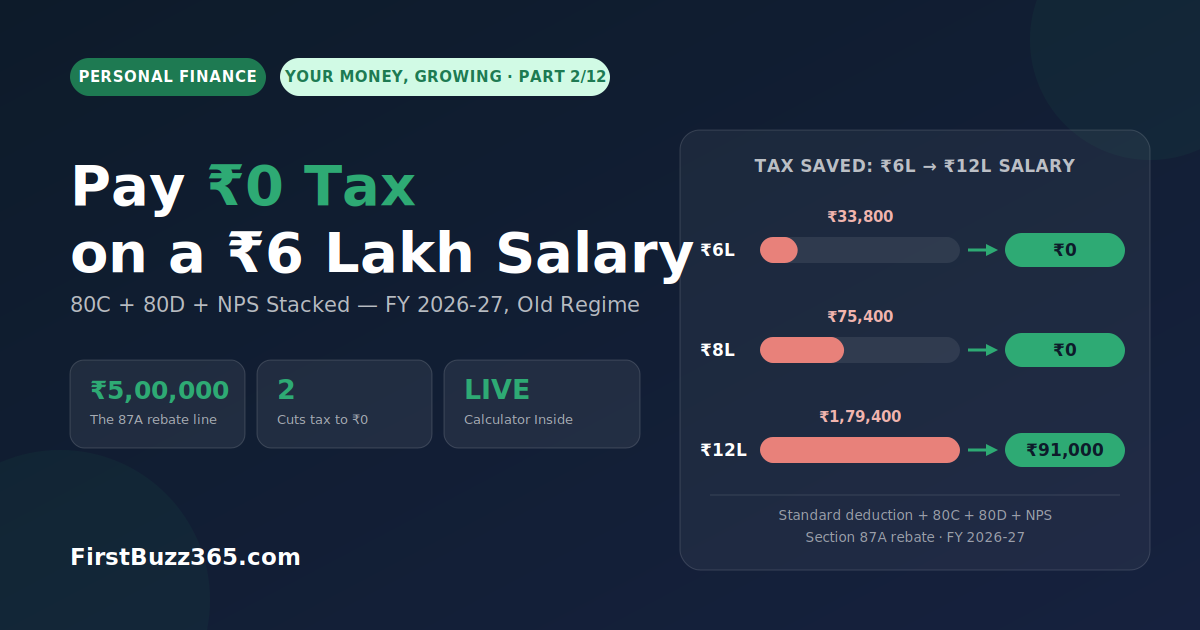
A salaried professional in Coimbatore earning ₹50,000 a month checks a tax calculator out of curiosity and sees roughly ₹33,800 leaving as income tax over the year — before touching a single deduction.
Two deductions, claimed correctly, take that number to zero. Not “reduced.” Zero. This isn’t a loophole — it’s Section 87A, and most articles explaining 80C never mention it.
This only works under the old tax regime, and it only works if the deductions are stacked correctly. But get the order wrong, and a salary that could owe nothing ends up paying anyway. This article works through the exact stack for ₹6 lakh, ₹8 lakh, and ₹12 lakh salaries, with every number checked twice.
Quick answer
Under the old tax regime, a ₹6,00,000 salary pays zero income tax in FY 2026-27 by claiming the ₹50,000 standard deduction plus the full ₹1,50,000 Section 80C limit — bringing taxable income to ₹4,00,000, under the ₹5,00,000 threshold where the Section 87A rebate wipes out the tax bill entirely. From there, health insurance (80D) and the National Pension System (NPS, 80CCD(1B)) extend this same zero-tax outcome up to roughly ₹8,00,000, and meaningfully reduce tax well beyond that.
A live calculator further down works out the exact stack for any salary — and the jump-to-section list below takes you straight to whichever section matters most.
✅ Quick self-check — is this stack actually right for you?
If you answered “not sure” to any of these, keep reading — each one is covered in detail below, with the exact numbers.
📑 Jump to a section
- 1Why Only the Old Regime
- 2Standard Deduction
- 3Section 80C — ₹1,50,000
- 4Section 80D — Health Insurance
- 5NPS, 80TTA & Employer NPS
- 6The Tax Optimisation Roadmap
- 7Myths, Debunked
- 8The Stack: ₹6L to ₹15L
- 9Old vs New Regime Calculator
- 10Case Study: Rahul, ₹9L
- 11What Changed in 2025
- 12Mistakes That Cost Money
- 13Documents You’ll Need
- 14Which Instrument Fits You
- 15Who Should NOT Use Old Regime
- 16What to Do This Week
📖 Five terms this article uses constantly — new to tax filing? Start here
1Why This Only Works Under the Old Regime
The new tax regime has been the default since FY 2023-24. For FY 2026-27 it charges nil tax up to ₹4,00,000, then 5%/10%/15%/20%/25%/30% in steps up to ₹24,00,000 — but its own Section 87A rebate (up to ₹60,000) means taxable income up to ₹12,00,000 owes nothing at all. Add the ₹75,000 standard deduction, and a new-regime salary is effectively tax-free up to ₹12,75,000. Still, what it doesn’t allow is Section 80C, 80D, or the employee’s own NPS contributions — none of the sections in this article apply there.
Only the old tax regime lets these deductions reduce taxable income. But here’s the honest part most tax articles skip: using just the stack in this article — 80C, 80D, and NPS, worth up to ₹3,25,000 — the new regime already matches or beats the old regime at every salary level, from ₹6 lakh to ₹50 lakh and beyond. Old regime pulls ahead only once other deductions this article doesn’t cover get added on top, chiefly House Rent Allowance (HRA) exemption and home loan interest under Section 24(b). Confirm the full picture using our old vs new tax regime comparison — the two aren’t interchangeable mid-year without informing the employer.
The comparison nobody runs the numbers on
At ₹9,00,000 salary with ₹1,20,000 in 80C and ₹20,000 in 80D — a realistic, not fully maxed, investor — old regime tax is ₹56,680. New regime tax on the same salary: ₹0, automatically, no investment required. Section 10 works through this exact case. This isn’t an argument against the old regime; it’s a reason to actually check both before assuming either one “obviously” wins.
The regime choice is made at the start of the financial year through the employer’s payroll declaration, or corrected while filing the Income Tax Return (ITR). It can’t be switched back and forth mid-year based on which deductions turn out to be higher.
2Standard Deduction: The ₹50,000 Everyone Gets, No Proof Needed
Every salaried employee and pensioner under the old regime gets a flat ₹50,000 deducted from gross salary automatically, under Section 16(ia) — no investment, no receipt, no declaration required. It’s the first number to subtract, before any of the sections below.
The new regime’s standard deduction is higher, at ₹75,000. That gap is one reason the new regime looks attractive on paper — but as the worked examples in Section 8 show, it disappears the moment 80C and 80D enter the picture.
3Section 80C: The ₹1,50,000 Limit Most People Already Half-Fill
Section 80C, now Section 123 under the Income-tax Act 2025, caps combined deductions at ₹1,50,000 a year across a specific list of instruments — most salaried employees are already partway there without realising it.
What counts toward the ₹1,50,000 limit
- Employee’s own EPF contribution — already deducted from every payslip
- Public Provident Fund (PPF)
- Equity Linked Savings Scheme (ELSS) mutual funds — 3-year lock-in, shortest of all 80C options
- Life insurance premium — up to 10% of sum assured for policies issued after April 2012
- National Savings Certificate (NSC)
- Home loan principal repayment
- Children’s tuition fees, up to two children
- 5-year tax-saver bank fixed deposit
- Sukanya Samriddhi Yojana, where applicable
A salaried professional contributing ₹1,800 a month to EPF is already at ₹21,600 of the ₹1,50,000 limit before opening a single new investment. So check the EPF passbook first — it’s the most commonly overlooked part of this section.
At the 20% slab, fully using the ₹1,50,000 limit saves ₹31,200 in tax including cess (₹1,50,000 × 20% × 1.04). At the 5% slab it still saves ₹7,800. The instrument barely matters for the saving itself — what matters is the ₹1,50,000 gets used.
4Section 80D: Health Insurance Premiums, Two Separate Buckets
Section 80D, now Section 126, allows up to ₹25,000 for health insurance covering self, spouse, and children — plus a separate, additional amount for parents’ health insurance that most people never claim.
| Who’s Covered | Deduction Limit |
| Self, spouse, children | ₹25,000 (under 60 years) |
| Self, spouse, children | ₹50,000 (taxpayer is a senior citizen, 60+) |
| Parents | ₹25,000 additional (parents under 60) |
| Parents | ₹50,000 additional (parents are senior citizens) |
A salaried professional under 60 with senior-citizen parents can claim ₹25,000 (self) + ₹50,000 (parents) = ₹75,000 total under 80D — separate from the ₹1,50,000 under 80C. In fact, this is the deduction most employees under-claim, usually because the parents’ policy is paid for but never declared.
5Section 80CCD(1B): The Extra ₹50,000 That Sits Outside 80C
An additional ₹50,000 deduction, now Section 124(3), is available for the employee’s own contribution to a Tier-I National Pension System (NPS) account — entirely separate from the ₹1,50,000 80C ceiling.
This is where most salaried professionals leave money on the table. That’s because Section 80C fills up fast with EPF and a home loan alone. Section 80CCD(1B) is a second, independent ₹50,000 slot that nothing else touches — a ₹50,000 NPS contribution here saves ₹15,600 in tax at the 30% slab, ₹10,400 at 20%, or ₹2,600 at 5%.
The trade-off: NPS Tier-I is locked until age 60, with 60% of the corpus tax-free at exit and 40% mandatorily annuitised. So it’s a genuine long-term commitment, not a parking spot for surplus cash at the end of March.
Section 80TTA — the ₹10,000 nobody files for
Interest earned on a savings bank account is deductible up to ₹10,000 a year under Section 80TTA, under the old regime — but only if it’s actually declared in the ITR, since banks don’t deduct Tax Deducted at Source (TDS) on small savings interest and it’s easy to forget. At the 20% slab it’s worth ₹2,080, for zero investment — only remembering to report interest that’s already sitting in the passbook.
The fifth lever most employees never ask for: employer NPS contribution
Everything so far comes from the employee’s own money. Instead, Section 80CCD(2) draws on what the employer pays into NPS on the employee’s behalf, and it sits completely outside every limit discussed above.
Under the old regime, an employer’s NPS Tier-I contribution is deductible up to 10% of Basic Salary + Dearness Allowance (DA) for private-sector employees, or 14% for Central and State Government employees. There’s no rupee ceiling — only the percentage cap. It doesn’t share the ₹1,50,000 Section 80C ceiling or the ₹50,000 Section 80CCD(1B) ceiling; it’s a fifth, independent bucket.
This isn’t automatic — most employers don’t offer it unless an employee asks, typically as part of a Cost to Company (CTC) restructuring where a slice of an allowance is redirected into an NPS contribution instead. Basic + DA is usually only 40–50% of total CTC, so the 10% cap applies to that smaller base, not the full salary used elsewhere in this article.
| Adding Employer NPS to the ₹12L Example | |
| Taxable income after Example 3’s full stack | ₹8,75,000 |
| Illustrative Basic + DA (≈50% of CTC) | ₹6,00,000 |
| Employer NPS contribution — Section 80CCD(2), 10% of Basic+DA | −₹60,000 |
| Revised taxable income | ₹8,15,000 |
| Revised tax + cess | ₹78,520 |
| Additional tax saved | ₹12,480 |
One cap to watch at higher salaries
Combined employer contributions to NPS, EPF, and superannuation above ₹7,50,000 a year become taxable as a perquisite in the employee’s hands. This rarely bites at ₹6L–₹12L salaries, but it’s worth knowing before asking an employer to maximise the NPS contribution.
“A rebate under Section 87A can reduce the tax liability to zero if net taxable income is up to ₹5,00,000.” Applied under the old regime, this single line is why a ₹6 lakh salary reaches zero tax without touching 80D or NPS at all.
6The Tax Optimisation Roadmap
Everything in Sections 2 through 5 works in a specific order. Follow this sequence rather than picking sections at random — it’s the difference between a plan and a scattered list of tax-saving ideas.

Two steps in this roadmap get skipped more than any others. The parents’ 80D bucket sits unused because nobody thinks to ask who’s paying the premium. And NPS gets opened before 80C is actually full, wasting the ₹1,50,000 ceiling’s remaining room on a section that didn’t need it yet.
7Common Tax-Saving Myths, Debunked
| Myth | Fact |
| Investing more than ₹1,50,000 in 80C saves more tax | False. The deduction caps exactly at ₹1,50,000 — anything beyond earns no further tax benefit under that section. |
| NPS is just “extra 80C” | Misleading. It’s a separate ₹50,000 limit under 80CCD(1B), but locked until age 60 — far less flexible than ELSS or PPF. |
| 80D for parents needs them to be dependent | False. The deduction follows whoever pays the premium, regardless of the parents’ own income or dependency status. |
| The old regime, fully stacked, always beats the new regime | False, and the reverse of common assumption. Section 8 and the Section 10 case study show the new regime matching or beating this article’s stack at every salary tested — old regime typically needs HRA or home loan interest added to pull ahead. |
| You need to use every section to save meaningful tax | False at ₹6 lakh. Standard deduction plus 80C alone reaches zero tax there — see Example 1 below. |
| Section 80C automatically means zero tax | False. 80C alone only reaches zero tax at salaries near ₹6 lakh, where the Section 87A rebate threshold does the actual work — not the deduction itself. |
| NPS is compulsory for tax saving | False. It’s the most optional section in this article — a 60-year lock-in that only makes sense once 80C and 80D are already in use. |
| Health insurance always saves ₹25,000 in tax | False. It saves tax on the premium paid, up to ₹25,000 — a ₹12,000 premium saves tax on ₹12,000, not the full ceiling. |
| Section 87A applies to everyone, automatically | False. It only zeroes out tax when taxable income is at or below the threshold (₹5,00,000 old regime, ₹12,00,000 new regime) — above that, ordinary slab tax applies with no rebate at all. |
8The Stack at ₹6L, ₹8L, ₹10L, ₹12L and ₹15L — What Actually Happens
At exactly ₹6,00,000 gross salary, standard deduction plus a fully-used 80C alone brings taxable income to ₹4,00,000 — under the ₹5,00,000 rebate line, which means the tax bill goes to zero without touching 80D or NPS at all.
Example 1 — ₹6,00,000 Salary
| Standard Deduction + 80C Only | |
| Gross salary | ₹6,00,000 |
| Standard deduction (Section 16(ia)) | −₹50,000 |
| Section 80C (EPF + PPF, fully used) | −₹1,50,000 |
| Taxable income | ₹4,00,000 |
| Tax on slabs (5% above ₹2,50,000) | ₹7,500 |
| Section 87A rebate (taxable income ≤ ₹5,00,000) | −₹7,500 |
| Final tax payable | ₹0 |
Without any deductions, the same ₹6,00,000 salary owes ₹33,800 in tax including cess. Standard deduction and 80C alone — no health insurance, no NPS — erase all of it.

Example 2 — ₹8,00,000 Salary, Two Scenarios
At ₹8 lakh, standard deduction and 80C alone are no longer enough — they leave a real, meaningful tax bill. So adding 80D and NPS closes the gap completely.
Partial — Std. Deduction + 80C Only
₹33,800
Taxable income ₹6,00,000 — above the rebate line
Full Stack — + 80D + NPS
₹0
Taxable income exactly ₹5,00,000 — rebate wipes it out
The full stack at ₹8 lakh: ₹50,000 standard deduction + ₹1,50,000 (80C) + ₹50,000 (80D — self ₹25,000, parents ₹25,000) + ₹50,000 (80CCD(1B) NPS) = ₹3,00,000 total. Taxable income lands at exactly ₹5,00,000 — the rebate ceiling — and the tax bill disappears.
Example 3 — ₹12,00,000 Salary
| Full Stack, Senior Citizen Parents | |
| Gross salary | ₹12,00,000 |
| Standard deduction | −₹50,000 |
| Section 80C | −₹1,50,000 |
| Section 80D (self ₹25,000 + senior parents ₹50,000) | −₹75,000 |
| Section 80CCD(1B) — NPS | −₹50,000 |
| Taxable income | ₹8,75,000 |
| Tax on slabs | ₹87,500 |
| Cess (4%) | ₹3,500 |
| Final tax payable | ₹91,000 |
At ₹12 lakh, taxable income sits well above the ₹5,00,000 rebate line even with the full stack — no rebate applies. But the same stack still cuts the bill from ₹1,79,400 (no deductions) to ₹91,000. That’s ₹88,400 saved — meaningful, not total.
The ₹12,00,000 example above assumes senior-citizen parents (₹50,000 80D limit). With parents under 60, the 80D limit for them drops to ₹25,000 — taxable income rises to ₹9,00,000, and final tax payable increases to roughly ₹96,200.

Example 4 — ₹10,00,000 Salary
| Full Stack, Senior Citizen Parents | |
| Gross salary | ₹10,00,000 |
| Total deductions (std. + 80C + 80D + NPS) | −₹3,25,000 |
| Taxable income | ₹6,75,000 |
| Tax + cess | ₹49,400 |
| Final tax payable (old regime, full stack) | ₹49,400 |
| Same salary, new regime (standard deduction only) | ₹0 |
At ₹10 lakh, the old regime’s full stack cuts tax from ₹1,17,000 (no deductions) to ₹49,400. But the new regime — with zero deductions, zero effort — already pays ₹0 at this salary. This is the pattern this article’s stack alone can’t beat past roughly ₹8.5 lakh: see Section 15 for when that changes.
Example 5 — ₹15,00,000 Salary
| Full Stack, Senior Citizen Parents | |
| Gross salary | ₹15,00,000 |
| Total deductions (std. + 80C + 80D + NPS) | −₹3,25,000 |
| Taxable income | ₹11,75,000 |
| Tax + cess | ₹1,71,600 |
| Final tax payable (old regime, full stack) | ₹1,71,600 |
| Same salary, new regime (standard deduction only) | ₹97,500 |
At ₹15 lakh, the gap widens further: old regime’s full stack still pays over ₹74,000 more than the new regime’s automatic ₹97,500 — with none of the lock-in, paperwork, or investment discipline the old-regime figure demands. This isn’t a reason to skip 80C, 80D, and NPS; it’s a reason to also claim House Rent Allowance (HRA) and home loan interest if you have them, since those are what actually tip this comparison back toward the old regime at higher salaries.
9Calculate the Exact Stack for Any Salary
Enter a gross annual salary and the deductions actually available. This calculator now includes House Rent Allowance (HRA) exemption and home loan interest alongside 80C, 80D, and NPS — the two deductions Section 15 identifies as what typically decides whether the old regime actually wins. Enter your real numbers and see both regimes side by side, rather than taking this article’s word for it.
80C + 80D + NPS + HRA + Home Loan — Old vs New Regime Calculator
| Total deductions applied | — |
| Taxable income | — |
| Tax before rebate | — |
| Section 87A rebate | — |
| Tax saved vs. no deductions | — |
| New regime, same salary (std. deduction only) | — |
| Better option at this salary | — |
This is an estimate for general understanding, not a tax filing document. It does not account for Section 80CCD(2) employer NPS contributions, surcharge above ₹50 lakh, marginal relief, or any deduction not listed above. Tax rules can change. Confirm your exact liability with a Chartered Accountant or the official Income Tax Department calculator at incometax.gov.in before making any financial decision.
10Case Study: Rahul, ₹9,00,000 Salary
Formulas are one thing. A single real profile, worked through completely, is what actually sticks. Rahul is a 29-year-old software engineer in Pune, salary ₹9,00,000, living with his parents (no rent, no HRA claim), no home loan yet.
| Rahul’s Actual Numbers — Not Fully Maxed | |
| Gross salary | ₹9,00,000 |
| Section 80C — EPF + one ELSS fund | ₹1,20,000 |
| Section 80D — self health cover only | ₹20,000 |
| NPS 80CCD(1B) | ₹0 — hasn’t opened an account |
Old Regime
₹56,680
Taxable income ₹7,10,000
New Regime
₹0
Taxable income ₹8,25,000 — under the ₹12L threshold
With Rahul’s actual, realistic numbers, the new regime saves him ₹56,680 — not because the old regime is bad, but because he isn’t using enough of it yet to overcome the new regime’s automatic exemption. Two follow-up questions matter more than the headline:
What if Rahul maxed out the entire stack?
Even fully maximised — ₹1,50,000 in 80C, ₹75,000 in 80D with senior-citizen parents added, ₹50,000 in NPS — Rahul’s old-regime tax drops to ₹28,600. Still ₹28,600 more than the new regime’s ₹0. For Rahul specifically, with no HRA and no home loan interest to claim, the old regime doesn’t win at any realistic level of 80C/80D/NPS investment.
What would change the answer?
If Rahul later takes a home loan and claims, say, ₹2,00,000 in Section 24(b) interest on top of a maxed stack, his old-regime taxable income drops enough to make the two regimes roughly comparable. That’s the real lesson: for someone renting with no home loan, this article’s stack alone rarely beats the new regime. Add HRA or home loan interest, and the calculation changes — see Section 15.
11What Changed Under the Income-tax Act 2025
Parliament passed the Income-tax Act 2025 on 12 August 2025, and it received Presidential assent on 21 August 2025. The Central Board of Direct Taxes (CBDT) notified the Income-tax Rules, 2026 on 20 March 2026 to operationalise it, and the Act came into force on 1 April 2026 (FY 2026-27) — a date CBDT’s own press release confirms was chosen specifically to give taxpayers a full year’s notice. Crucially, that same press release describes the Act as changing “structure and presentation… without altering the underlying tax policy” — official confirmation that this is a renumbering exercise, not a change to any limit in this article.
How the section numbers map
Every deduction in this article keeps its rupee value under the new Act — only the label changes. The table below shows exactly where each familiar section lands, so a Chartered Accountant or payroll system quoting the new number is easy to translate back.
| Old Number (1961 Act) | New Number (2025 Act) |
| Section 80C | Section 123 |
| Section 80D | Section 126 |
| Section 80CCD(1B) | Section 124(3) |
| Section 80CCD(2) | Section 124 |
| Section 87A (rebate) | Section 156 |
| Section 16(ia) (standard deduction) | Section 19 |
Nothing about the ₹1,50,000, ₹25,000/₹50,000, or ₹50,000 limits themselves changed — only the section labels did. An employer’s payroll software or a Chartered Accountant quoting “Section 123” instead of “80C” for FY 2026-27 income is referring to the same deduction. For FY 2025-26 returns filed by July 2026, the old 1961 Act numbers still apply on Form 16 and the ITR portal — the new numbers only govern income earned from April 2026 onward.
Two more renamed terms worth knowing
“Financial Year” and “Assessment Year” are replaced by a single term, “Tax Year,” so FY 2026-27 income is simply Tax Year 2026-27 under the new Act. Form 16 — the certificate every salaried employee gets each year — is expected to be reissued as Form 130 once payroll systems fully migrate, though FY 2025-26’s Form 16 keeps its current name and numbering. Neither change affects any figure in this article; both are worth recognising the next time they show up on a payslip or in an ITR portal update.
The Union Budget, presented 1 February 2026, made no changes to old-regime slabs, the ₹1,50,000 Section 80C limit, Section 80D’s ₹25,000/₹50,000 tiers, or the Section 87A rebate threshold — despite pre-Budget speculation that 80C might rise to ₹3,00,000 and 80D to ₹50,000. Every figure in this article reflects the confirmed, unchanged FY 2026-27 position, not the speculation.
12Mistakes That Quietly Cost Real Money
Beyond missing sections entirely, these errors show up again and again in how salaried professionals handle this stack — each one is fixable in under ten minutes, except the last, which just takes a moment of honesty.
Declaring an amount, not the instrument
Form 12BB asks for the deduction amount, not just intention. A gap between declared and actual proof gets clawed back from the final month’s salary in one go.
Ignoring who actually pays the premium
The parents’ 80D deduction follows whoever pays — not automatically the person named on the policy. Document the payment trail if more than one adult child could claim it.
Treating NPS like flexible 80C
ELSS becomes accessible after 3 years, PPF partially after 5. NPS Tier-I stays locked until 60. So only put genuinely long-term money into the 80CCD(1B) slot.
Buying insurance only for the tax break
A policy bought purely to fill 80D, with no real regard for coverage, hospital network, or claim history, often turns out useless exactly when it’s needed. Tax saving is a side effect of good insurance, not the reason to buy it.
Funding ELSS before an emergency fund exists
ELSS locks money for 3 years with no early exit. Redirecting rent or EMI money into it before building a cash buffer turns a tax-saving move into a liquidity crisis the first time something goes wrong.
Assuming NPS or the old regime is “always best”
Neither is universal. NPS suits long horizons with locked-in discipline; the old regime suits employees with HRA or home loan interest to claim. Section 10 and Section 15 work through exactly when each assumption breaks.
Investing beyond ₹1,50,000 in 80C-eligible instruments saves nothing further under that section — the excess simply sits as a regular investment with no additional tax benefit. Fill the ₹1,50,000 ceiling exactly, then redirect any further surplus to 80CCD(1B) or straight investing.
13Documents You’ll Need
Every deduction in this stack needs paperwork behind it — for the employer’s Form 12BB declaration in January, and again if the assessing officer ever asks during ITR processing. Keep these ready before investment season gets busy:
📄 Proof documents by section
14Which Instrument Fits Your Situation
Not every employee’s salary and family situation looks like the standard examples above. Here’s how to place yourself correctly before applying this article’s stack.
Salary near ₹6 lakh
The easiest zero-tax path. Standard deduction plus a fully-used 80C is enough — 80D and NPS aren’t required, though they add a safety margin.
Salary ₹8–10 lakh, parents uninsured
80C alone leaves real tax owed. Health insurance for parents is usually the single missing piece that gets this range to zero.
Salary ₹12 lakh+
The full stack still saves close to ₹90,000, but won’t reach zero. NPS discipline and senior-citizen parent insurance matter most here.
Which instrument fits you — a quick guide
Six common situations, and the instrument that typically fits each one best. These aren’t rules — they’re starting points for the many 80C, 80D, and NPS options in this article.
Young, salaried, 20s–early 30s
ELSS — shortest 80C lock-in at 3 years, equity exposure fits a long investing horizon.
Conservative, risk-averse
PPF — government-backed, tax-free maturity, no market risk of any kind.
Long retirement horizon
NPS (80CCD(1B)) — an extra ₹50,000 deduction, but only for money genuinely fine being locked until 60.
Already maxed ₹1,50,000 under 80C
Move to 80CCD(1B) next — it sits entirely outside the 80C ceiling, a second independent ₹50,000 slot.
Parents financially dependent, uninsured
Section 80D for parents — the most under-claimed deduction in this entire stack. See Section 4.
No emergency fund yet
Build 3–6 months of expenses in something you can access immediately before locking money into ELSS or NPS.
If there’s no HRA or home loan interest to claim, confirm the new regime isn’t already the better deal — Section 15 works through exactly when that’s true.
15Who Should NOT Use the Old Regime
Most tax articles spend all their time explaining deductions and almost none explaining when to skip them entirely. Based on the numbers worked through in this article, the old regime is the wrong choice for:
- Anyone with no HRA and no home loan interest to claim. Section 8’s examples show this plainly — using just 80C, 80D, and NPS, the new regime matches or beats the old regime at every salary level tested, from ₹6 lakh to ₹50 lakh.
- Anyone who won’t actually invest the money. The old regime’s advantage only exists if 80C, 80D, and NPS are genuinely used. Staying in the old regime “just in case” while leaving those sections empty means paying more tax for nothing.
- Anyone who needs liquidity over the next few years. ELSS locks money for 3 years, PPF for much longer, NPS until 60. If building an emergency fund matters more right now, the new regime’s automatic exemption doesn’t force any of that trade-off.
- First jobs and salaries under roughly ₹8 lakh. The new regime already reaches zero tax with no effort in this range — old regime investments still make sense as a savings habit, but not as a tax strategy.
Employees paying real rent without employer-provided housing (HRA exemption), anyone repaying a home loan (Section 24(b) interest, up to ₹2,00,000), and higher earners who can genuinely max the full stack plus those two — that combination is where the old regime consistently pulls ahead.
16What to Actually Do This Week
📋 Your tax-stacking action list
The Bottom Line
A ₹6 lakh salary doesn’t need every section in this article to reach zero tax — just standard deduction and a fully-used 80C, kept under the ₹5,00,000 Section 87A rebate line. Above that, 80D and NPS pick up the slack, and even at ₹12 lakh the same four sections cut the bill by nearly ₹90,000. This week: check your EPF passbook, confirm the old regime is declared, and insure your parents before 31 March if that box is still unticked.
❓ अक्सर पूछे जाने वाले प्रश्न
The old regime and rebate math
Yes, but differently. The new regime already exempts taxable income up to ₹12 lakh through its own Section 87A rebate, so a ₹6 lakh salary owes zero tax there without any 80C or 80D investment — it just doesn’t let you claim those sections at all.
The ₹5,00,000 refers to net taxable income — after standard deduction and every other deduction has already been subtracted from gross salary. It’s the final number on which slab tax is calculated.
Using Section 80C correctly
No. In fact, EPF, existing life insurance premiums, home loan principal, and children’s tuition fees all count automatically. Add up what’s already happening on the payslip and in existing policies before opening anything new.
The deduction still caps at ₹1,50,000 — the excess earns no additional tax benefit under that section, though it may still earn its own investment return. Instead, redirect surplus to Section 80CCD(1B) NPS, since that’s a separate ₹50,000 ceiling.
80D and NPS specifics
Yes. The deduction depends on who pays the premium, not the parents’ income. If the taxpayer pays the premium on a policy covering the parents, it’s claimable regardless of whether the parents file their own return.
Only if the ₹50,000 is genuinely long-term money. NPS Tier-I is locked until age 60, with partial-withdrawal exceptions only for specific events like a child’s education, medical treatment, or a first home. It isn’t a flexible tax-saving park.
Yes — this is a legitimate Cost to Company (CTC) restructuring request, not a special favour. Under Section 80CCD(2), the employer’s contribution (up to 10% of Basic+DA for private-sector employees) is deductible with no rupee ceiling, separate from every other section in this article. Ask HR whether corporate NPS is available before assuming it isn’t.
Filing and the Income-tax Act 2025
Not for FY 2025-26 filings. The Income-tax Act 2025 renumbering applies from FY 2026-27 onward. Form 16 for income earned up to 31 March 2026 will still show the familiar 80C, 80D, and 80CCD(1B) labels.
Yes — the deduction applies to whatever interest was actually earned, up to a ₹10,000 ceiling. If the interest is ₹4,000, the deduction is ₹4,000, not the full ₹10,000.
No. The Union Budget presented on 1 February 2026 left old-regime slabs, the ₹1,50,000 Section 80C limit, Section 80D’s tiers, and the Section 87A rebate threshold unchanged, despite speculation beforehand that some of these might rise. Every figure here reflects the confirmed FY 2026-27 position.
Choosing between old and new regime
Rarely, on its own. Using just this article’s stack — up to ₹3,25,000 in deductions — the new regime matches or beats the old regime at every salary level from ₹6 lakh to well past ₹50 lakh, as Section 8 and the Section 10 case study both show. The old regime typically only pulls ahead once House Rent Allowance (HRA) or home loan interest under Section 24(b) are added on top.
It depends on whether you’re chasing zero tax or just meaningful savings. Section 14’s decision matrix and Section 15 walk through this by situation, but as a starting point: near ₹6 lakh, standard deduction plus 80C is enough; from ₹8–10 lakh, add health insurance; above that, NPS and — if you have them — HRA or home loan interest start to matter more than any single 80C investment.
EPF and PPF passbooks, an ELSS account statement, life insurance premium receipts, health insurance payment receipts (separately for self and for parents if both are claimed), and an NPS contribution receipt showing the PRAN. Section 13 has the complete list by section.
📖 Read These Next
Old Tax Regime vs New Tax Regime
Confirm which regime actually suits your salary before stacking any of these deductions.
HRA Exemption Explained
House Rent Allowance (HRA) exemption sits on top of everything in this article — claim both under the old regime.
Form 16 Explained
Where every deduction in this stack should show up once your employer issues Form 16.
EPF vs PPF vs NPS
All three count toward this article’s stack differently — understand each before allocating.
One useful money article a week
Salary, tax, credit, EPF — practical breakdowns for India’s salaried professionals. No spam, unsubscribe any time.
Primary Government Sources
Income-tax Act, 1961 — Section 80C (₹1,50,000 limit), Section 80D (health insurance), Section 80CCD(1B) (NPS additional ₹50,000), Section 80TTA (savings interest), Section 87A (rebate), Section 16(ia) (standard deduction): incometax.gov.in.
Central Board of Direct Taxes (CBDT), Press Release, “Income-tax Act, 2025 comes into force from 1st April, 2026” (dated 1 April 2026) — confirms Parliament passage (12 Aug 2025), Presidential assent (21 Aug 2025), Income-tax Rules 2026 notification (20 March 2026), and explicitly states the Act changes structure and presentation “without altering the underlying tax policy”: incometaxindia.gov.in.
Income-tax Act, 2025 [30 of 2025], full Gazette text, Section 19(1) Table Sl. No. 2 — read directly from the official Act text: standard deduction is “₹75000 or the salary, whichever is less, where income-tax is computed under section 202(1)” (new regime) or “₹50000 or the salary, whichever is less, in any other case” (old regime). The same text confirms the ₹7,50,000 aggregate employer-contribution cap (Section 17(1)(h)) and Section 124 as the NPS/pension-scheme provision: incometaxindia.gov.in.
Income Tax Department, Section 19 — “Deductions from salaries,” Chapter IV, Income-tax Act, 2025: confirms Section 19 as the renumbered home of the standard deduction, replacing Section 16(ia): incometaxindia.gov.in.
Central Board of Direct Taxes (CBDT) and Income Tax Department notifications on standard deduction figures for FY 2026-27 (old regime ₹50,000, new regime ₹75,000) and Union Budget 2026 (presented 1 February 2026), confirming no change to old-regime slabs, 80C, or 80D limits: incometaxindia.gov.in.
Additional Sources
Income-tax Act, 2025 — section renumbering (80C → 123, 80D → 126, 80CCD → 124, 80CCD(1B) → 124(3), 87A → 156, new regime/115BAC → 202): corroborated across multiple independent tax-platform sources, including a Chartered Accountant-built section-mapping tool.
Section 80CCD(2) employer NPS contribution limits (10% of Basic+DA, private sector, old regime; 14% for Central/State Government employees) and the ₹7,50,000 aggregate employer-contribution cap under Section 17(2)(viiaa): corroborated across multiple pension-industry and tax-platform sources.
💬 Quick Question for You
Between EPF, PPF, and a home loan, is your Section 80C already close to full — or does the NPS route under 80CCD(1B) matter more for your salary bracket?