
Types of Mutual Funds in India: Which Category Do You Actually Need?
A salaried professional in Coimbatore opens a mutual fund app and taps “Start SIP” (Systematic Investment Plan — a fixed amount invested automatically every month). Before deciding what the money is actually meant to achieve, they’re shown a wall of fifty-odd fund names: Large Cap, Flexi Cap, Aggressive Hybrid, Contra Fund. None of these category names get explained at the point of purchase. And as of 26 February 2026, the regulatory rulebook behind these names changed in ways that almost nothing published online yet reflects.
This guide works through all five SEBI-defined fund classes and the 13 equity categories inside them. It also covers exactly what changed in February and why it might affect a fund already sitting in your portfolio. It ends with a quick tool that turns your own time horizon and risk comfort into a specific category to research next. Not a stock tip — a category, which is the level of decision that actually matters before picking a scheme.
Quick self-check — do you actually know your own fund’s category?
If you answered “not sure” to any of these, the sections below walk through each one with the exact fix.
Jump to a section
- 1What a Fund Category Actually Controls
- 2The 5 Broad SEBI Categories
- 3The 13 Equity Categories, Explained
- 4What Changed on 26 February 2026
- 5Debt, Hybrid & Life Cycle Funds
- 6Where to Check Your Own Fund
- 7Why the Category Beats the Star Rating
- 8Which Category Fits You — Quiz
- 9Mistakes to Avoid
1What a Fund Category Actually Controls — and Why It’s Not Just a Label
If you’re completely new to this: a mutual fund pools money from thousands of investors and uses it to buy a basket of investments — shares in companies, government or company loans, gold, or a mix of these — on their behalf. A professional fund manager decides what to buy and sell within the rules of the fund’s category, and each investor owns a proportional slice of the whole basket, called a “unit.” That’s the entire idea. The category is what decides which basket the fund is allowed to build.
A fund’s category is a binding commitment to SEBI about what it can and can’t hold — not a marketing description. If two funds share almost the same name but sit in different categories, they are legally required to behave differently, whatever their star ratings say.
Most salaried investors start a SIP because a colleague mentioned a fund, an app recommended one, or a bank relationship manager suggested “something for tax saving.” The fund gets picked before the category is understood. That’s backwards — and completely understandable, since nobody explains this at the point of purchase.
A Large Cap Fund, for example, is contractually required to keep at least 80% of its money in India’s 100 biggest companies by market value. A Small Cap Fund is required to do close to the opposite. Two funds can sound similar and carry completely different risk once you know what the category actually permits. After February 2026, SEBI tightened exactly this gap between a fund’s name and what it’s allowed to hold.
Why this matters more this year than most
SEBI’s Categorization and Rationalization circular of 26 February 2026 is one of the more significant mutual fund rule changes in years — it replaces the framework nearly every existing “types of mutual funds” article was written against. That means a search today for this topic mostly surfaces information that’s already out of date, which is the specific gap this article fills.
2The 5 Broad SEBI Fund Categories You’ll See on Every Scheme
Every mutual fund sold in India falls into exactly one of five SEBI-defined classes: Equity, Debt, Hybrid, Life Cycle Funds, or Other Schemes. The fourth class is new terminology as of February 2026, replacing what used to be called Solution-Oriented Schemes.
How the old classification maps to the new one
| Old vs New Top-Level Classification | |
| Before 26 Feb 2026 | From 26 Feb 2026 |
| i. Equity Schemes | A. Equity Scheme — 13 categories, 4 with raised equity minimums |
| ii. Debt Schemes | B. Debt Scheme — structure largely unchanged |
| iii. Hybrid Schemes | C. Hybrid Scheme — 7 categories retained, new residual-asset flexibility |
| iv. Solution-Oriented Schemes | D. Life Cycle Funds — new category, replaces Children’s/Retirement Funds |
| v. Other Schemes | E. Other Schemes — Fund of Funds + passive schemes (Index Funds/ETFs) |
The “Other Schemes” class covers funds that don’t pick individual stocks themselves — Fund of Funds (a scheme that invests in other mutual funds rather than directly in shares or bonds) and passive schemes such as Index Funds and ETFs (Exchange-Traded Funds, which track a market index like the Nifty 50 and trade on a stock exchange like a share).
These schemes stopped accepting new investment immediately from 26 February 2026 and will eventually be merged into a similar-risk scheme, subject to SEBI’s approval. This affects a genuinely large number of investors, since Children’s and Retirement Funds were popular goal-based choices for years before this category existed.
Check your fund house’s notice board or the email linked to your folio (your unique account number with that fund house) for the merger notification, rather than assuming your SIP continues unchanged. Scheme mergers under SEBI’s mutual fund regulations typically require consent from unitholders (the term for anyone who owns units in the fund — meaning you) and often waive the exit load (a fee normally charged for withdrawing early) for investors who choose to redeem instead of continuing into the merged scheme. This waiver is not guaranteed for every transition, so confirm the specific terms in your fund house’s own merger communication before deciding whether to stay or exit.
3The 13 Equity Fund Categories, Explained in Plain Language
Equity funds are where most long-term SIPs for goals 7 or more years away actually sit, and they now come in 13 SEBI-defined categories — up from 11. Four of them (Dividend Yield, Value, Contra, and Focused funds) had their minimum equity requirement raised from 65% to 80% under the February 2026 circular, meaning these funds now behave more purely like equity than before.
All 13 categories and what each one is bound to hold
| The 13 Equity Fund Categories (SEBI, effective 26 Feb 2026) | ||
| Category | What it must hold | Min. equity |
| Multi Cap Fund | At least 25% each in large-, mid-, and small-cap companies | 75% |
| Large Cap Fund | India’s top 100 companies by market value | 80% |
| Large & Mid Cap Fund | At least 35% large-cap + at least 35% mid-cap | 70% |
| Mid Cap Fund | Predominantly mid-sized companies (101st-250th) | 65% |
| Small Cap Fund | Predominantly small companies (251st onward) | 65% |
| Flexi Cap Fund | Fund manager’s discretion across large/mid/small | 65% |
| Dividend Yield Fund | Predominantly high-dividend-yielding stocks | 80% (was 65%) |
| Value Fund | Value-investing strategy (undervalued stocks) | 80% (was 65%) |
| Contra Fund | Contrarian strategy — against prevailing sentiment | 80% (was 65%) |
| Focused Fund | Maximum 30 stocks in the portfolio | 80% (was 65%) |
| Sectoral Fund | One named sector only (e.g. banking, pharma) | 80% |
| Thematic Fund | A theme spanning 2+ sectors — now separated from Sectoral | 80% |
| ELSS (Equity-Linked Savings Scheme) – Tax Saver Fund | Equity-linked, 3-year lock-in, Section 80C eligible | 80% |
Separately from SEBI’s fund categories, the tax law behind ELSS changed its address this year too. The Income Tax Act, 2025 replaced the Income-tax Act, 1961 from 1 April 2026, and the familiar Section 80C deduction was renumbered to Section 123, under Chapter VIII of the new Act (with eligible instruments now listed in Schedule XV). The ₹1,50,000 combined ceiling and the old-regime-only rule are unchanged — only the section number and paperwork references have moved. Returns for FY 2025-26 still use Section 80C; returns for FY 2026-27 onward use Section 123 for the same benefit.
“Mutual Funds shall be permitted to offer both Value and Contra funds subject to the condition that scheme portfolio overlap between the two schemes shall not be more than 50%.”
Category at a Glance: Which One Actually Fits Most Salaried Investors
Thirteen categories is a lot to hold in your head. Here are the six a typical salaried investor is most likely to actually use, and the one-line reason each gets picked.
| Six Categories Most Salaried Investors Actually Use | |
| Category | Typically picked when… |
| Flexi Cap Fund | You want one core equity holding and would rather the fund manager handle the large/mid/small mix than decide it yourself. The most common default choice for a first long-term SIP. |
| Large Cap Fund | You want equity exposure but with lower comfort for sharp swings — money in India’s 100 biggest, most-established companies. |
| Large & Mid Cap Fund | You want more growth potential than pure Large Cap without the full volatility of Mid or Small Cap — a deliberate middle ground. |
| Mid Cap / Small Cap Fund | Your horizon is genuinely 7+ years and you can sit through a 30%+ drawdown (a drop in value from a recent peak) without selling — return potential comes with real volatility. |
| ELSS – Tax Saver Fund | Section 123 (formerly 80C) tax saving is the actual goal, and you’re certain you won’t need the money for at least 3 years. |
| Aggressive Hybrid / Conservative Hybrid | You want a single fund with a built-in equity-debt mix, rather than managing that balance across separate equity and debt schemes yourself. |
4What Changed on 26 February 2026 — And Why It Might Affect a Fund You Already Own
SEBI’s Categorization and Rationalization Circular (the same 26 February 2026 circular introduced in Section 1) didn’t just raise a few thresholds. It tightened naming rules, capped how similar two funds from the same AMC (Asset Management Company — the firm that manages a mutual fund’s investments and is regulated by SEBI) are allowed to be, and replaced an entire fund class. Here’s what changed, beyond the equity percentages already covered above.
Portfolio overlap caps — the “closet indexing” fix
Sectoral and Thematic equity schemes can no longer overlap by more than 50% with other equity schemes, whether in their own category or across most other equity categories. Large Cap schemes are exempt from this specific comparison. The same 50% cap now applies between a fund house’s own Value and Contra funds.
The rule exists to stop a fund house from selling investors two or three “different” schemes that are quietly built from nearly the same portfolio — a practice sometimes called closet indexing, where a fund charges an active-management fee while behaving like a near-duplicate of another scheme it already runs. Capping overlap forces genuine differentiation between schemes, not just different marketing names on the same underlying bet.
Overlap is calculated quarterly, using the average of daily portfolio values, at the level of individual securities — each identified by its ISIN (International Securities Identification Number, a unique code for every stock or bond) — the circular’s own methodology sums the smaller of the two funds’ weights in every stock or bond they both hold.
SEBI didn’t just say “3 years to comply” — it set a specific pace. Existing sectoral and thematic schemes must realign 35% of their excess overlap in year one, another 35% in year two, and the remaining 30% in year three. A scheme that still fails after three years must be merged with another scheme.
Naming rules — no more “Super Growth” style names
A scheme’s name can no longer emphasise return potential in a way its category doesn’t back up. The circular also requires the scheme name to match its category name exactly, for uniform identification across fund houses. If a fund’s name changed slightly in 2026 without the SIP amount or folio number changing, this is very likely why — check the factsheet before assuming anything else happened.
Monthly overlap disclosure
Fund houses must now publish a monthly portfolio overlap disclosure on their own websites. Each equity scheme is compared against every other equity scheme they run, each debt scheme against every other debt scheme, and each hybrid against every other hybrid. The circular sets a general 6-month compliance window for existing schemes to fall in line with the new rules overall. This disclosure should be live by roughly August 2026, though the circular text does not name that exact date for this specific requirement.
Say you hold two or three “different” funds from the same AMC. If they sound distinct but have quietly been investing in nearly the same companies, this monthly disclosure is where you’ll actually be able to check that — instead of guessing from the fund names.
5Debt, Hybrid, and Life Cycle Funds — What Each One Is Actually For
Debt funds — now 17 categories, sorted by Macaulay Duration
Debt fund categories are sorted by Macaulay Duration — a measure of how sensitive the fund is to interest rate changes — from shortest to longest. The February 2026 circular renamed several duration bands and added a genuinely new category: Sectoral Debt Funds.
| The 17 Debt Fund Categories (SEBI, effective 26 Feb 2026) | ||
| Category | Holds | Duration / rule |
| Overnight Fund | Securities maturing in 1 day | 1 day |
| Liquid Fund | Debt & money market instruments | Up to 91 days |
| Ultra Short Term Fund | Debt & money market instruments | Macaulay duration 3-6 months |
| Ultra Short to Short Term Fund | Debt & money market instruments | Macaulay duration 6-12 months |
| Money Market Fund | Money market instruments | Up to 1 year maturity |
| Short Term Fund | Debt & money market instruments | Macaulay duration 1-3 years |
| Medium Term Fund | Debt & money market instruments | Macaulay duration 3-4 years |
| Medium to Long Term Fund | Debt & money market instruments | Macaulay duration 4-7 years |
| Long Term Fund | Debt & money market instruments | Macaulay duration >7 years |
| Dynamic Term Fund | Debt across durations | Across all durations |
| Corporate Bond Fund | AA+ and above rated corporate bonds | Min. 80% of assets |
| Credit Risk Fund | AA and below rated corporate bonds | Min. 65% of assets |
| Banking & PSU Debt Fund | Banks, PSU, PFI, municipal bonds | Min. 80% of assets |
| Gilt Fund | Government securities, any maturity | Min. 80% of assets |
| 10-Year Constant Maturity Gilt Fund | Government securities | Macaulay duration = 10 years |
| Floating Interest Rates Fund | Floating-rate instruments | Min. 65% of assets |
| Sectoral Fund (Debt) | One named sector, AA+ and above bonds | Min. 80% of assets — NEW |
This is a genuinely new debt category, and the circular names the sectors it can be launched in: Financial Services, Energy, Infrastructure, Housing, and Real Estate. An AMC must also confirm there’s enough investment-grade paper available in that sector before launching one — a safeguard against thin, hard-to-diversify portfolios.
In the equity category schemes, Mutual Funds may also invest a small residual portion in equity, money market and other liquid instruments, gold and silver instruments, and InvITs (Infrastructure Investment Trusts — pooled vehicles that own income-generating infrastructure assets like roads or power lines) — a detail that applies across the equity table in Section 3, not just here.
Hybrid funds — seven categories, defined by their equity band
| The 7 Hybrid Fund Categories | |
| Category | Equity allocation band |
| Conservative Hybrid | 10%-25% equity, 75%-90% debt |
| Balanced Hybrid | 40%-60% equity, 40%-60% debt (no arbitrage permitted) |
| Aggressive Hybrid | 65%-80% equity, 20%-35% debt |
| Dynamic Asset Allocation Fund | Equity and debt only, managed dynamically |
| Multi-Asset Allocation | At least 3 asset classes, min. 10% each |
| Arbitrage Fund | Min. 65% equity + hedge; debt capped to govt. securities under 1-year maturity and govt. bond repos; no InvIT investment permitted |
| Equity Savings | Min. 65% equity (net exposure 15%-40%), min. 10% debt, rest arbitrage |
A genuinely useful addition from the February 2026 circular: hybrid schemes other than Arbitrage funds can now hold a residual portion in Gold ETFs, Silver ETFs, InvITs, and ETCDs (Exchange-Traded Currency Derivatives — contracts used to hedge currency risk, traded on an exchange). That gives fund managers more room to diversify without breaking the category’s core equity-debt promise to you.
Life Cycle Funds — the new goal-based category, with a real glide path
A Life Cycle Fund runs on a pre-set glide path: high equity exposure early on, automatically stepping down toward debt and gold/silver as the fund’s target maturity date gets closer. Tenures run from 5 to 30 years in 5-year steps, and each AMC can run up to six such schemes at a time. As a fund approaches under one year to maturity, it may be merged into the nearest-maturity Life Cycle Fund the AMC runs — but only with the unitholders’ positive consent, not automatically.
| Life Cycle Fund Glide Path (30-Year Fund, SEBI Annexure B) | |||
| Years to maturity | इक्विटी | Debt | Gold/Silver/InvITs |
| 15-30 years | 65%-95% | 5%-25% | 0%-10% |
| 10-15 years | 65%-80% | 5%-25% | 0%-10% |
| 5-10 years | 50%-65% | 5%-25% | 0%-10% |
| 3-5 years | 35%-50% | 25%-50% | 0%-10% |
| 1-3 years | 20%-35% | 25%-65% | 0%-10% |
| Under 1 year | 5%-20% | 25%-65% | 0%-10% |
Schemes are named after their maturity year — Life Cycle Fund 2045, Life Cycle Fund 2055, and so on — so the target date is visible in the name itself, not buried in the factsheet. Exiting early costs a graded fee: 3% within the first year, 2% within the second, and 1% within the third, which is the circular’s way of discouraging withdrawals before the glide path does its job.
How Each Category Is Actually Taxed
The category also decides your tax bill, separately from SEBI’s rules — this comes from the Income Tax Act, 2025, not from SEBI. Here is the quick version; a full dedicated article on mutual fund capital gains is planned for this series.
Held over 12 months (called Long-Term Capital Gains, or LTCG): taxed under Section 112A at 12.5%, with the first ₹1,25,000 of gains in a financial year exempt. Held 12 months or under (Short-Term Capital Gains, or STCG): taxed under Section 111A at a flat 20%. No indexation benefit either way.
Under Section 50AA, these are taxed entirely at your income-tax slab rate, regardless of how long you hold them — there is no concessional long-term rate and no indexation, unlike the pre-2023 rules many older articles still describe.
These typically fall under the general Section 112 rate of 12.5% for gains after a 24-month holding period, without indexation, and at slab rate if sold sooner — but the exact treatment depends on the specific scheme’s asset mix, so check the scheme’s own tax communication rather than assuming.
6Where to Check Which Category Your Own Fund Belongs To
Your fund’s category is printed on the first page of its Scheme Information Document (SID) and its monthly factsheet — both free on your fund house’s website and on the website of AMFI (Association of Mutual Funds in India, the industry body for Indian mutual funds). It’s worth checking even if you’ve held the fund for years.
Three places to look, in order of speed
- Your folio statement or app. Most fund apps list the category directly under the fund name — look for a line reading “Equity — Flexi Cap” or similar.
- The fund’s monthly factsheet, published by the AMC on its own website. This also shows top holdings, so you can see the category promise in practice.
- AMFI’s website (amfiindia.com), which maintains investor education material on the categorisation framework and lists registered schemes by category.
Fund houses must also publish a monthly portfolio overlap disclosure on their own websites. If you hold two funds from the same AMC that sound different but quietly invest in nearly the same companies, this disclosure is where you’d catch it.
7Why the Category Matters More Than the Fund’s Star Rating
A star rating compares a fund to others that already share its category. So two funds with identical five-star ratings can carry completely different risk if they sit in different categories — the rating is relative, the category is the actual constraint.
Same rating, very different risk
A 5-star Small Cap Fund and a 5-star Large Cap Fund are both “the best in their category,” but a bad year for small caps and a bad year for large caps are not the same size of bad year. The rating tells you the fund manager did well relative to peers who took a similar level of risk. It says nothing, however, about whether that risk actually suits your own money.
This is also the entire point of the February 2026 circular. SEBI’s own language for the goal is that schemes stay “true-to-label”. A fund’s name and category should match what it actually holds, so a Focused Fund with 80% equity behaves like a focused equity bet — not a watered-down version wearing a more exciting name.
Where each category sits, relatively
This is a relative positioning, not a return forecast: each category’s SEBI-mandated equity composition places it at a different point on a rough risk spectrum, running from money-market-safe to concentrated-and-volatile. Historical returns for any specific fund can fall outside this ordering in any given year — this is about category design, not a performance prediction.
8Which Fund Category Fits You — A 3-Question Tool
Three inputs decide the right category for you: whether the goal is Section 80C tax saving, how long before you need the money, and how you’d actually react to a 20% drop. Not how you think you’d react — how you actually would. Answer honestly and the category narrows itself down.
What this looks like at three real salary levels
The category decides where the money goes. The amount depends on your own salary. Here’s what a typical 15% investable surplus looks like once rent, EMIs, and groceries are accounted for, and which category that money would suit for a 7+ year goal at moderate risk comfort:
| A 15% Monthly Surplus, by Salary — 7+ Year Goal, Moderate Risk Comfort | |||
| Monthly salary | 15% surplus | Suggested category | 10-yr value @ 12% CAGR* |
| ₹30,000 | ₹4,500/month | Flexi Cap or Multi Cap Fund | ≈ ₹10.4 lakh |
| ₹50,000 | ₹7,500/month | Flexi Cap or Multi Cap Fund | ≈ ₹17.4 lakh |
| ₹80,000 | ₹12,000/month | Flexi Cap or Multi Cap Fund | ≈ ₹27.8 lakh |
*Illustrative SIP future-value calculation at a 12% assumed annual return, compounded monthly — not a guarantee, and not specific to any scheme. Actual returns depend entirely on the fund chosen and market conditions.
A 12% CAGR (Compound Annual Growth Rate — the average yearly growth rate assuming gains are reinvested) is a planning assumption, not a promise. Flexi Cap and Multi Cap funds can also post negative years — a fall of 15%-25% in a single year has happened before and will happen again. This table only makes sense for money you genuinely will not need for 7 or more years.
Find Your Mutual Fund Category — and What It Could Grow To
| – |
| Monthly investment (starting amount) | – |
| Annual step-up applied | – |
| Projection period | – |
| Illustrative return assumed* | – |
| Total you’d invest | – |
| Illustrative projected value | – |
| Assumed inflation (for real value)† | – |
| Value in today’s ₹ (inflation-adjusted) | – |
9Common Mistakes Salaried Investors Make With Fund Categories
Chasing last year’s top performer
A Sectoral or Thematic fund near the top of the charts this year is frequently near the bottom the next — that’s what “one sector, up to 80% equity, no diversification cushion” means in practice.
Owning five funds that are really one bet
Several “different” Flexi Cap or Large Cap funds from different AMCs often hold overlapping stocks. The new overlap disclosures (from August 2026) make this easy to check — actually check it.
Small Cap for a 4-year goal
Small Cap Fund’s minimum 65% equity in smaller companies means sharper drawdowns and slower recoveries — a category meant for 7+ year money used for a 4-year goal is a mismatch, not a risk-tolerance issue.
ELSS – Tax Saver Fund carries a mandatory 3-year lock-in, the shortest among Section 80C options, but still a lock-in. Money you might need in year 2 shouldn’t go into ELSS regardless of the tax benefit.
The Mistake That Costs the Most: Switching Categories After a Bad Year
None of the four mistakes above is as expensive as this one. An investor picks a category correctly — say, Flexi Cap for a 10-year goal — then abandons it the moment it has a rough 12 months, moving to whatever category performed best that same year. This resets the clock on every advantage a long holding period was supposed to deliver, and it usually means selling low and buying high in the same move.
The fix is procedural, not clever: decide the category based on your own horizon and risk comfort, as covered in Section 8, and only revisit that decision when your horizon or risk comfort genuinely changes — not when a 1-year return number changes. A category chosen correctly does not need to be re-chosen every time the market has an opinion about it.
The Bottom Line
Picking a mutual fund by its name or its star rating resembles choosing a flight by the airline’s logo — it tells you almost nothing about where the plane is actually going. The category is the flight plan, and SEBI’s February 2026 rules exist specifically to stop that plan from being disguised as something it isn’t.
Before your next SIP instalment, spend two minutes checking your existing fund’s category against what you actually need it to do. If they don’t match your own time horizon and comfort with a 20% drop, that’s worth fixing before it costs years of compounding in the wrong direction.
Do this in the next 7 days: (1) open your fund app and note the exact category under each holding, (2) check whether any category name or minimum-equity figure changed after 26 February 2026, (3) if you hold a Children’s or Retirement Fund, look for the merger notification, and (4) run the quiz above and compare its suggestion to what you already hold.
Get the category right once, at the start, and everything else in this article is just fund-amentals.
Frequently Asked Questions
SEBI recognises five broad classes: Equity, Debt, Hybrid, Life Cycle Funds, and Other Schemes (index funds, ETFs, and fund-of-funds). Equity alone splits into 13 categories such as Large Cap, Flexi Cap, and ELSS, defined by SEBI Circular HO/24/13/15(2)2026-IMD-RAC4/I/5764/2026, effective 26 February 2026.
SEBI raised the minimum equity requirement from 65% to 80% for Dividend Yield, Value, Contra, and Focused funds. It also split Sectoral and Thematic into separate categories, discontinued Solution-Oriented Schemes in favour of a new Life Cycle Funds class, and introduced quarterly portfolio-overlap caps.
There’s no single best category — it depends on your time horizon. Money needed within 3 years suits Debt categories; 3-7 years suits Hybrid categories; 7+ years suits equity categories like Flexi Cap or Large & Mid Cap. The tool above narrows this to your specific answers in under a minute.
ELSS, now formally called ELSS – Tax Saver Fund, is an equity category with a mandatory 3-year lock-in, the shortest among Section 80C options like PPF (Public Provident Fund) or NSC (National Savings Certificate). It invests at least 80% in equity, carrying market risk that fixed-income 80C options don’t, in exchange for potentially higher long-term returns.
SEBI discontinued the Solution-Oriented Schemes category effective 26 February 2026. Existing schemes stopped accepting new investments immediately and will be merged into similar-risk schemes with SEBI’s approval. A new Life Cycle Funds category now serves the same goal-based, glide-path purpose.
Check your fund app or folio statement, which usually lists the category under the fund name, or look at the fund’s monthly factsheet on its AMC’s website. AMFI’s website also lists registered schemes by their current SEBI category.
Portfolio overlap measures how much two funds hold the same underlying stocks or bonds. AMCs must disclose this monthly on their own websites, expected within the circular’s general 6-month compliance window (roughly August 2026). High overlap between funds you hold means you’re paying two expense ratios (the annual fee, as a percentage of your investment, that a fund charges for managing your money) for what is functionally one bet — worth checking if you hold multiple funds from one AMC.
Yes, and as of February 2026 a single fund house can offer both — previously it had to choose one. Both now require a minimum 80% equity allocation, and their portfolios must not overlap by more than 50%, so the two strategies stay genuinely distinct rather than duplicating each other.
Only for FY 2025-26 returns. The Income Tax Act, 2025 replaced the 1961 Act from 1 April 2026, and Section 80C was renumbered to Section 123, with eligible investments now listed in Schedule XV. The ₹1,50,000 deduction ceiling and the old-regime-only rule are unchanged — only the section number and paperwork references moved, effective from Tax Year 2026-27 onward.
Read These Next
पुराना टैक्स रिजीम बनाम नया टैक्स रिजीम: 2026 में कौन सा आपको अधिक बचाता है?
ELSS’s Section 80C benefit only applies under the old regime — see how the two regimes actually compare for your salary.
Emergency Fund India 2026: Your Real ₹ Target, Not a Guess
Build this first — a Debt or Liquid fund category from this article is exactly what an emergency fund should sit in.
Why Your ₹75,000 CTC Pays You Only Around ₹65,000 Take-Home
Working out what you can actually invest each month, before deciding which fund category to put it in.
SIP vs Lumpsum: Which Is Right for a Fixed Monthly Salary?
Once you’ve picked a category, how to actually put money into it — SIP or lumpsum.
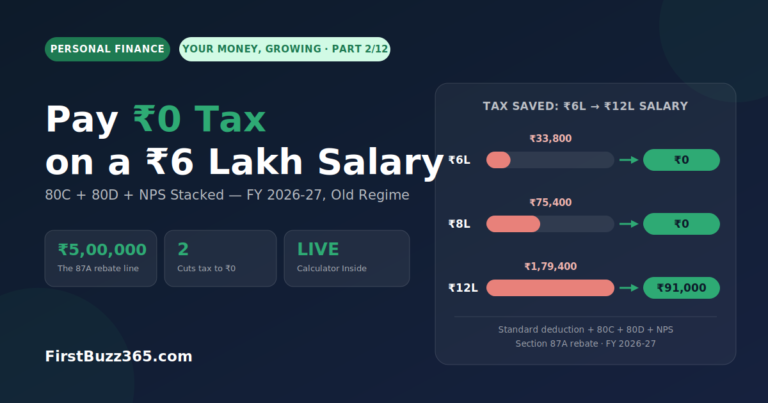
How to Pay Zero Tax on a ₹6 Lakh Salary: 80C, 80D, and NPS Stacked
Where ELSS fits alongside your other Section 80C deductions.
Get Every Part of Your Money, Growing
SIP, tax stacking, mutual funds, demat accounts, gold, Fixed Deposits (FD) vs Recurring Deposits (RD) — one practical breakdown at a time.
- New parts of this 12-part investing series as they publish
- The exact worked calculations, before anyone else sees them
- Unsubscribe in one click, any time
Your email is only used to send this newsletter and occasional updates from FirstBuzz365. Unsubscribe any time.
- Securities and Exchange Board of India — Categorization and Rationalization of Mutual Fund Schemes. Circular No. HO/24/13/15(2)2026-IMD-RAC4/I/5764/2026, dated 26 February 2026, defining all fund categories and thresholds in this article: sebi.gov.in
- Securities and Exchange Board of India — Master Circular for Mutual Funds. Dated 20 March 2026, the current consolidated compliance reference superseding the 27 June 2024 version: sebi.gov.in
- Income Tax Department, Government of India — Section 123, Income Tax Act, 2025. Successor to Section 80C of the Income-tax Act, 1961, governing the ₹1,50,000 ELSS deduction ceiling: incometaxindia.gov.in
- Association of Mutual Funds in India (AMFI). Investor education material and registered-scheme lookup by category, referenced in Section 6: amfiindia.com
Quick Question for You
Did you already know which SEBI category your own SIP falls under before reading this — or did checking today’s factsheet turn up a surprise?