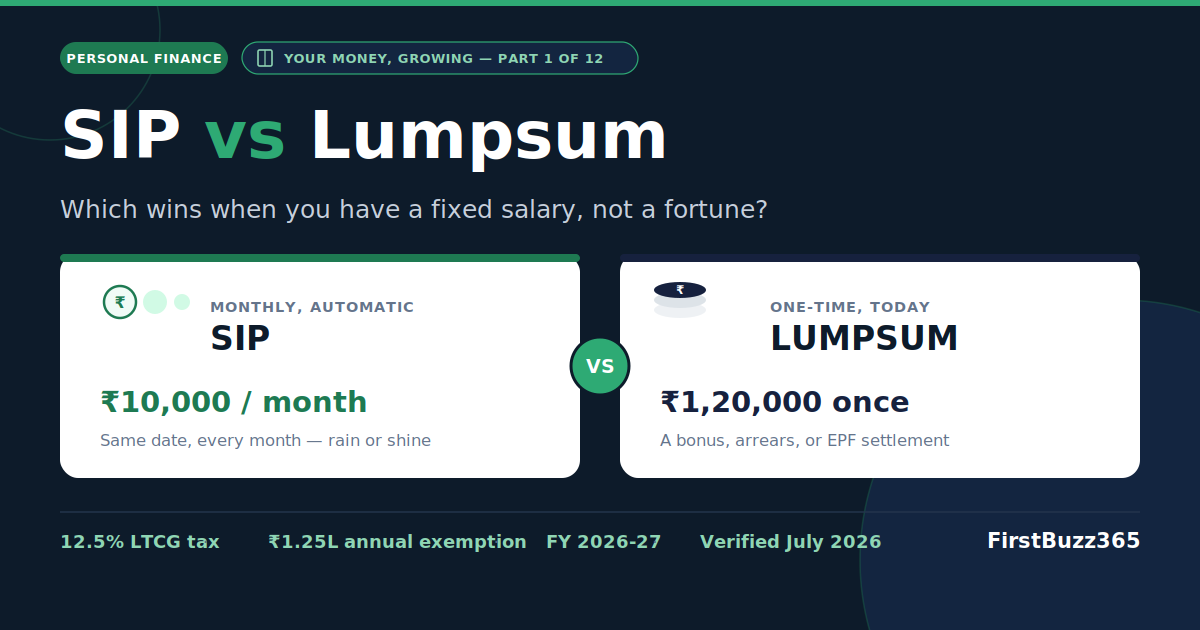
SIP vs Lumpsum: Which Is Right When You Have a Fixed Salary Every Month?
Most salaried professionals in India face the same dilemma every time they get a bonus, increment, or tax refund: invest it all at once as a lumpsum, or spread it through SIPs? The honest answer is — it depends on whether you already have the full amount, or are still earning it month by month. This article shows exactly which approach wins in real Indian salary conditions, using ₹10,000/month worked examples.
The 12% figure above is an assumed annual return, used only for illustration throughout this article — not a projection, promise, or guarantee of actual returns. “LTCG” above is short for Long-Term Capital Gains tax, explained fully in Section 5. Section 6B covers the downside risk an average return like this can hide.
In short, you’ll get three worked scenarios with real rupee figures, exactly how each is taxed, and a calculator that runs your own numbers through both methods at once.
Quick Self-Check — Are You Asking the Right Question?
- 1.
Do you already have the money, or are you saving toward it? Indeed, these are two different questions with two different right answers — most “SIP vs lumpsum” content only answers the second one.
- 2.
Are you assuming SIP always wins? Actually, it doesn’t, mathematically — Section 3 shows exactly when a lumpsum of equal size outperforms a SIP, and why that’s not a contradiction.
- 3.
Do you know that a single SIP can be taxed two different ways at once? After all, each instalment has its own 12-month clock. Section 5 covers what most investors get wrong here.
If any of those gave you pause, the sections below work through each one with actual rupee figures.
- What SIP Actually Is (It’s a Method, Not a Product)
- How Much Should You Actually Invest? Three Salary Levels
- What Lumpsum Means on a Salary
- Three Real Scenarios, Real Rupees
- Rupee Cost Averaging in a Falling Market
- How SIP and Lumpsum Are Actually Taxed
- Nominal Returns vs Real Returns
- SIP vs Lumpsum Calculator
- The Risk This Article Hasn’t Mentioned Yet
- When Lumpsum Genuinely Wins
- Getting Started, and What Happens If You Miss a Month
- The One Mistake That Costs SIP Investors the Most
- Common SIP vs Lumpsum Myths
1What SIP Actually Is (It’s a Method, Not a Product)
Before SIP and lumpsum make sense, one thing needs to be clear: a mutual fund is a pool of money collected from many investors, invested together by a professional fund manager — usually in a mix of company shares (called equity) or bonds. When you invest, your money buys a small slice of that pool, called a unit, the same way a slice of a cake belongs to whoever bought it. The value of each unit moves up or down as the value of everything the fund holds changes. SIP and lumpsum are simply two different ways of buying those units — nothing more.
SIP stands for Systematic Investment Plan, and it is not a type of mutual fund. Instead, it is a way of buying units in any mutual fund scheme — a fixed amount, on a fixed date, every month. The fund itself doesn’t change. Only the timing of your purchases does.
Every SIP instalment buys units at that month’s Net Asset Value, or NAV. When the market is expensive, your ₹10,000 buys fewer units. If it falls instead, the same ₹10,000 buys more. As a result, this averages your purchase price over months and years — you’re never fully exposed to buying everything at one peak.
For a salaried professional, SIP has a second advantage that has nothing to do with markets: it matches how your money actually arrives. After all, you get paid once a month. So investing once a month, automatically, close to your salary date, means the money leaves before you find a reason to spend it.
1BHow Much Should You Actually Invest? Four Real Salary Levels
“Invest 10–20% of your salary” is the advice everywhere and it tells you nothing. So here’s what a 15% SIP allocation actually looks like in rupees, at four real Indian salary levels, projected 10 and 20 years at the same 12% assumed return used throughout this article — an illustrative long-term equity average, not a promised or guaranteed rate.
| Monthly Salary | SIP at 15% | 10-Year Illustrative Post-Tax Corpus | 20-Year Illustrative Post-Tax Corpus |
|---|---|---|---|
| ₹30,000 | ₹4,500/month | ₹4,57,960 | ₹30,04,770 |
| ₹50,000 | ₹7,500/month | ₹7,52,850 | ₹49,97,533 |
| ₹80,000 | ₹12,000/month | ₹11,95,185 | ₹79,86,678 |
| ₹1,20,000 | ₹18,000/month | ₹17,84,965 | ₹1,19,72,205 |
“Illustrative Post-Tax Corpus” (corpus simply means the total amount your investment has grown to) assumes the entire gain is withdrawn at once at the end of the period, taxed as long-term capital gains (LTCG) at 12.5% above the ₹1.25L annual exemption (Section 112A) — the same simplification used throughout this article. It is an estimate for comparison, not a projection or a promise of actual returns.

The percentage stays fixed at 15% across all three rows — only the salary changes. That’s deliberate: it shows the outcome scales with income, not with some hidden advantage higher earners get from the market. The mechanism is identical for a ₹30,000 salary and an ₹80,000 one; only the rupee amount going in each month differs.
This doesn’t apply if
You don’t yet have the commonly recommended 3–6 months of expenses set aside in an emergency fund — see our Emergency Fund guide for how that figure is derived before starting any SIP.
It also doesn’t apply if you’re carrying unpaid, revolving credit card debt. The RBI’s (Reserve Bank of India’s) Master Direction on Credit Card and Debit Card Issuance (RBI/2022-23/92, updated March 2024) requires every card-issuer to disclose its exact interest rate and Annual Percentage Rate on your billing statement, rather than fixing one rate for the whole market — so your card’s real rate is on your own statement, not a number this article can quote for you.
What the Master Direction does confirm is that this interest compounds (grows on top of interest already added, not just on the original amount you borrowed) and is charged from the transaction date if the bill isn’t paid in full. As a result, revolving card debt is one of the most expensive forms of borrowing available to a salaried professional — expensive enough that no realistic SIP return is likely to outpace it.
In both cases, that comes first: a market-linked SIP is the wrong place to keep money you might need on short notice, or money that’s actively losing to interest you’re already paying.
2What Lumpsum Means on a Salary
A lumpsum is a single, one-time purchase of mutual fund units. For someone with a fixed salary, a genuine lumpsum rarely comes from routine savings alone. Instead, it usually comes from one of three sources.
| Source | Typical Size | Frequency |
|---|---|---|
| Annual bonus or variable pay | Varies by employer, role, and appraisal cycle | Once a year |
| Increment arrears | Back-dated to the hike’s effective date, varies by employer | Irregular |
| EPF (Employees’ Provident Fund) settlement | Full accumulated balance | On job change |
None of these are “extra” money in the sense of being disposable. Rather, they deserve the same discipline as a monthly SIP — which is exactly why this comparison matters for a salaried reader, and gets skipped by articles written for people who trade for a living. If an EPF settlement is the source, it’s worth comparing how that money would have grown left untouched — see our EPF vs PPF vs NPS comparison before deciding.
3Three Real Scenarios, Real Rupees
All three scenarios assume a 12% expected annual return — a commonly used long-term assumption for diversified equity mutual funds, not a guarantee. Still, actual returns vary and can be negative in any given year. Each table below also shows a tax figure — Section 5 explains exactly how that’s calculated, so for now, just treat the rate as given.
Scenario A — ₹10,000/month SIP for 10 years
| Metric | Value |
|---|---|
| Total invested | ₹12,00,000 |
| Value at end of Year 10 | ₹23,23,391 |
| Total gain | ₹11,23,391 |
| Estimated LTCG tax (12.5% above ₹1.25L exemption) | ₹1,24,799 |
| Illustrative post-tax gain (full redemption, LTCG assumed) | ₹9,98,592 |
Scenario B — ₹1,20,000 lumpsum, invested once, held 10 years
| Metric | Value |
|---|---|
| Total invested | ₹1,20,000 |
| Value at end of Year 10 | ₹3,72,702 |
| Total gain | ₹2,52,702 |
| Estimated LTCG tax | ₹15,963 |
| Illustrative post-tax gain (full redemption, LTCG assumed) | ₹2,36,739 |
That’s the realistic comparison for this reader: someone who never had ₹12 lakh sitting idle, only ₹10,000 a month. Even so, side by side, the SIP investor’s post-tax gain is roughly ten times higher — but they also put in ten times the capital.

The Honest Comparison Most Articles Skip
Say you actually had ₹12,00,000 free today. Invest all of it as a single lumpsum at 12% for 10 years, and it grows to roughly ₹37,27,018 — a post-tax gain near ₹22,26,766, more than double Scenario A’s outcome on the same total capital. Money invested on day one simply compounds for longer than money invested gradually. Section 7 covers exactly when a lumpsum is the better call.

Scenario C — ₹5,000/month SIP for 20 years (start early, invest less)
| Metric | Value |
|---|---|
| Total invested | ₹12,00,000 |
| Value at end of Year 20 | ₹49,95,740 |
| Total gain | ₹37,95,740 |
| Estimated LTCG tax | ₹4,58,842 |
| Illustrative post-tax gain (full redemption, LTCG assumed) | ₹33,36,897 |
Once again, the same ₹12,00,000 is invested as in Scenario A, at the same 12% assumption — but stretched over 20 years at half the monthly amount instead of 10 years at double. The post-tax outcome is more than three times higher. Clearly, time in the market did more work here than the size of each instalment.
4Rupee Cost Averaging in a Falling Market
Rupee cost averaging is the mechanical reason SIP is forgiving of bad timing. So here’s a 12-month example where the fund’s NAV falls for six months, then recovers to exactly where it started.
| Metric | Value |
|---|---|
| Monthly SIP | ₹10,000 |
| NAV path (₹) | 10 → 9 → 8 → 7 → 8 → 9 → 10 → 11 → 12 → 13 → 10 → 10 |
| Total invested (12 months) | ₹1,20,000 |
| Units accumulated | 12,662.45 |
| Value at NAV ₹10 (same as start) | ₹1,26,624 |
Notice the NAV ends exactly where it began — a flat, round-trip year. A lumpsum investor who put in ₹1,20,000 on day one and held through this exact path would show zero gain, since every unit was bought at the starting NAV. However, the SIP investor gained ₹6,624, because a portion of their instalments bought units cheaply during the dip. In other words, volatility on its own worked in the SIP investor’s favour here — not because the market rose, but because the price moved around.

5How SIP and Lumpsum Are Actually Taxed
Under Section 112A of the Income Tax Act, gains on equity shares and equity-oriented mutual fund units held for more than 12 months are long-term capital gains (LTCG). Specifically, these are taxed at 12.5%, with the first ₹1,25,000 of gains in a financial year exempt. Otherwise, gains on units held 12 months or less are short-term capital gains (STCG), taxed at a flat 20% under Section 111A — this applies regardless of which income tax regime you’ve chosen for your salary. These rates have applied since 23 July 2024 and remain unchanged through Financial Year (FY) 2026-27, verified directly against incometaxindia.gov.in in July 2026. (Effective from Budget 2024, the ₹1.25 lakh exemption on LTCG still applies. Surcharge and cess may increase the effective rate for high earners.)
Here is the part most people miss: a SIP is not one investment — it is a new, separate investment every month. Each instalment gets its own 12-month holding-period clock, starting from its own purchase date. Redeem (sell your units and convert them back to cash) a 3-year SIP in one go, and your earliest instalments have easily crossed 12 months — they qualify for LTCG. But instalments from the last few months before redemption may still be under 12 months old. Consequently, those specific units are taxed as short-term gains at 20%, even though the SIP itself is three years old.
By contrast, a lumpsum has only one purchase date, so the entire investment crosses into LTCG territory together, on one clean date, 12 months after you invested.
In Plain English
Think of a running SIP as 36 tiny, separate purchases if it’s been going 3 years — not one big investment. Sell everything today, and the oldest purchases (older than 12 months) get the cheaper 12.5% tax rate. Instead, the newest few — bought in the last year — get taxed at 20%. A lumpsum has just one purchase date, so the whole thing flips to the cheaper rate together, on one clean day.
Practical Takeaway
Redeeming a long-running SIP soon, and want the whole thing taxed as LTCG? Redeem at least 12 months after your most recent instalment — or expect the newest slice of units to be taxed at the higher 20% short-term rate.
Tax laws change
Everything in this section reflects the law as verified against incometaxindia.gov.in in July 2026. Tax laws change periodically — often with each Union Budget. Always verify the latest Finance Act, or consult a qualified tax professional, before making an investment decision based on today’s rates.
5BNominal Returns vs Real Returns
Every number in this article so far — ₹23.2L, ₹9,98,592, ₹79.87L — is a nominal figure. It’s what your account balance would show, in the rupees of that future year. Specifically, it says nothing about what those rupees can actually buy, and that gap matters more the longer your money stays invested.
India’s inflation target, set by the Government of India in consultation with RBI under Section 45ZA of the RBI Act, 1934, is 4% with a tolerance band of 2–6% — reaffirmed for the five-year period from April 2026 to March 2031. So if your SIP grows at a 12% nominal return while prices rise at 4% a year, your real return — the growth in what your money can actually purchase — works out to roughly 7.7% a year, not 12%.
| Inflation Scenario | Approx. Real Return (12% Nominal) | Scenario A’s ₹23.2L in Today’s Purchasing Power |
|---|---|---|
| 4% (RBI’s target) | ~7.7% | ₹15.7L |
| 6% (RBI’s upper tolerance band) | ~5.7% | ₹12.97L |
In other words, Scenario A’s headline ₹23,23,391 after 10 years is real money — but it won’t feel like ₹23.2L feels today. Depending on where inflation actually lands within RBI’s band, it will feel closer to somewhere between ₹13L and ₹16L in today’s terms. Neither SIP nor lumpsum escapes this — inflation erodes both equally, since it’s a property of the rupee, not the investment method. Still, it’s a reason to treat every “final value” figure in this article as a ceiling on optimism, not a promise.
Before you use this
In “I save monthly” mode, the second row shows what would happen if you magically had the full yearly amount today — which most salaried people don’t. It illustrates the cost of timing, not a real option available to you.
SIP vs Lumpsum Calculator
See what your monthly SIP grows to — and, for honest comparison, what the same total money would be worth if you had it all as a lumpsum today (which you don’t, but it shows what timing costs).
Assumes gains are entirely long-term at redemption (12.5% above ₹1.25L exemption) and excludes surcharge/cess. See Section 5 for how instalment-wise taxation can differ from this simplification.
Assumes a 12% annualised return (illustrative long-term equity average) — not a guarantee. Results shown above are estimates only, not guaranteed returns; see Section 6B for how much an equity portfolio can realistically fall before it recovers.
6BThe Risk This Article Hasn’t Mentioned Yet
Every calculation so far assumes a smooth 12% a year. Real markets don’t work that way. Equity mutual funds — the kind this entire article is about — can lose 20%, 30%, even 40% of their value during a bear market, sometimes within a matter of months. That’s not a remote scenario; it’s happened to Indian equity markets multiple times in the past two decades.
This doesn’t make SIP or lumpsum a bad idea. Rather, it means the 12% figure used throughout this article is a long-term average, smoothed over years that include both sharp falls and strong recoveries — not a rate your portfolio moves at smoothly, month to month. A SIP running through a 30% drawdown — the term for how far a portfolio’s value falls from its peak before recovering — will show a red, unpleasant portfolio screen for a while.
Its rupee-cost-averaging mechanism, covered in Section 4, softens the damage by buying more units at lower prices, but it doesn’t prevent the drawdown itself. A lumpsum invested right before a crash faces the same fall with no cushioning at all, since every rupee entered at the same, now-inflated price.
Before you decide
If a 30–40% temporary fall in your portfolio’s value would push you to panic-sell, that’s a real signal about your risk tolerance — not a reason to avoid equity mutual funds altogether, but a reason to size your SIP or lumpsum so that a bad year doesn’t derail your other financial commitments. This article can show you the maths; only you can decide how much overnight volatility you can actually sit through.
7When Lumpsum Genuinely Wins
In fact, lumpsum is the better choice in three specific situations — as a matter of maths and risk, not opinion:
- You already have the money, and the market has just fallen sharply. Deploying a lumpsum right after a correction captures the recovery in full, instead of spreading purchases across a rising market.
- Your investment horizon is genuinely long — 15 years or more. Over very long periods, markets have historically trended upward often enough that time in the market outweighs the timing risk of a single entry point.
- You have a one-time windfall you were going to invest anyway. Splitting a bonus or EPF settlement into a 6–12 month staggered plan only makes sense if you’re genuinely worried about entering at a market peak — not as a default habit.
SIP
You don’t have the lumpsum to begin with — SIP matches income timing and removes the need to guess market entry points with money you’re still earning.
Lumpsum
Money already sitting idle compounds for longer when deployed immediately — Section 3’s honest comparison shows exactly how much longer.
8Getting Started, and What Happens If You Miss a Month
- Decide your monthly amount first, from your actual surplus — not an aspirational number. Work that out before opening any investment account.
- Choose direct plans over regular plans where you’re comfortable researching funds yourself. Every mutual fund charges a small annual fee, called the expense ratio, to cover its running costs — “regular” plans build a distributor’s commission into that fee, while “direct” plans skip the distributor and charge less. Over 10–20 years, that difference compounds into a meaningfully larger corpus.
- Complete KYC (Know Your Customer verification) — your PAN (Permanent Account Number), Aadhaar-linked e-KYC, and a bank account, done once through any AMC’s (Asset Management Company’s — the firm that runs the mutual fund) website or a SEBI-registered (Securities and Exchange Board of India-registered) platform. See our Groww vs Zerodha vs Upstox comparison if you’re deciding where to open one.
- Set the SIP date 2–3 days after your salary credit, not on the 1st — this avoids failed debits if your salary is delayed by a day or two, which happens more often than most people plan for.
- Set up auto-debit, called a NACH (National Automated Clearing House) mandate, so the instalment happens without a manual decision each month. This single step matters more than fund selection for most beginners.
| Your Salary Credits On | Set Your SIP Date To | Why |
|---|---|---|
| 1st of the month | 3rd or 4th | Covers weekend/holiday processing delays without missing the debit window |
| Last working day | 2nd–3rd of the following month | “Last working day” shifts monthly — a fixed date avoids guessing |
| 7th (common for some employers) | 9th or 10th | Same buffer principle — 2–3 working days of cushion |
If you miss an instalment
Missing one SIP instalment because of a delayed salary or a cash crunch does not cancel your SIP. Most AMCs allow 2–3 consecutive failed debits before pausing the mandate automatically — check your specific fund house’s policy, since it varies. Even so, a missed instalment simply means that month’s units were never bought; it doesn’t reverse or penalise units you already hold. Instead, resume the very next month rather than trying to “catch up” with a larger one-time top-up — chasing the make-up amount is a common source of badly timed, impulsive investing.
9The One Mistake That Costs SIP Investors the Most
Stopping the SIP the moment the market falls
The single most expensive mistake in this comparison isn’t choosing SIP or lumpsum — it’s pausing a SIP during a market fall out of discomfort. As Section 4 shows, a falling market is precisely when your fixed instalment buys more units for the same money. So stopping removes the one mechanical advantage SIP has over a badly timed lumpsum, at the exact moment it matters most.
The fix is mechanical, not complicated: treat the SIP date like a bill you can’t skip, not a decision you re-evaluate every month based on the headlines. Granted, a five-second glance at a falling NAV feels like a loss. Still, over a 10-year horizon, it’s usually the reason the SIP investor ends up ahead.
SIP doesn’t beat a lumpsum of equal size on pure maths — it exists because most people don’t have the lumpsum yet, and because it keeps working exactly when willpower is hardest to find.
— The core finding of Section 3’s worked examplesThe Bottom Line
If you have a fixed salary and no large lumpsum sitting idle, SIP is the right default. Not because it mathematically outperforms a lumpsum of equal size — because it’s the only method that matches how your money actually arrives. Still, if a genuine windfall lands in your account and your horizon is long, deploying it as a lumpsum usually earns more than staggering it out of caution.
Think of it the way you’d think about paying for a scooter. A down payment upfront doesn’t make the scooter cheaper than paying it off through EMIs (Equated Monthly Instalments) — the on-road price is the same either way. Instead, what changes is whether you can afford it today. So SIP is the EMI version of investing: it doesn’t beat a cash purchase on price, but it makes the purchase possible on a salary that arrives once a month.
Your one action today: open your mutual fund app, set the SIP date 2–3 days after your salary credit date, and turn on auto-debit before you close this tab. After all, the five-minute setup matters more than getting the fund selection perfect on day one. A SIP, fittingly, rewards the investor who sips steadily — not the one who gulps once and hopes for the best.
10Common SIP vs Lumpsum Myths
A few claims about SIP and lumpsum circulate so often that they’re treated as settled fact. Based on the maths worked through in this article, none of them hold up.
Myths About Which One Wins
- 1.
Myth: SIP always gives better returns than lumpsum. Section 3’s honest comparison shows the opposite, when the capital is equal — a lumpsum invested on day one usually earns more than the same money spread out, because it compounds for longer.
- 2.
Myth: Lumpsum investing is only for rich people. A lumpsum is just money invested in one sitting rather than spread out. A ₹5,000 tax refund invested all at once is a lumpsum, exactly like a ₹5 lakh bonus is.
Myths About Safety and Guarantees
- 3.
Myth: SIP guarantees profits. SIP is a purchase method, not a guarantee. As Section 6B covers, the equity funds a SIP buys into can still fall 20–40% in a bad year, regardless of how the units were purchased.
- 4.
Myth: Missing one SIP instalment ruins your investment. Section 8 covers this directly — a missed instalment simply means that month’s units were never bought. Nothing already invested is reversed or penalised.
- 5.
Myth: SIP protects you from market crashes. SIP softens your average entry price through rupee cost averaging (Section 4), but it doesn’t shield money you’ve already invested. In a genuine crash, your existing corpus falls regardless of whether it arrived via SIP or lumpsum.
Frequently Asked Questions
Is SIP better than lumpsum for a salaried person in India?
Not in a strict mathematical sense. If you already had the full lumpsum amount, investing it all on day one usually earns more over the same horizon, since it compounds for longer. Still, SIP is better suited for a salaried person because it matches how income actually arrives monthly and removes the need to time the market with money you’re still earning.
What happens to my SIP if I miss one month’s instalment?
Nothing is reversed or penalised. That month’s units simply aren’t purchased. Most AMCs pause the mandate only after 2–3 consecutive missed debits. Instead, resume the next month rather than trying to make up the missed amount as a lumpsum top-up.
How is SIP taxed in India — is it LTCG or STCG?
Both, potentially, within the same SIP. Specifically, each monthly instalment is treated as a separate investment with its own 12-month holding period. Instalments older than 12 months at redemption qualify for LTCG (12.5% above ₹1.25 lakh exemption); instalments younger than 12 months are taxed as STCG at 20%.
Can I do both SIP and lumpsum in the same mutual fund?
Yes. Most AMCs allow both a running SIP and additional one-time lumpsum purchases in the same folio (a mutual fund account number, similar to a bank account number for that scheme). Each lumpsum purchase is tracked with its own separate holding period for tax purposes.
What is the minimum SIP amount in India in 2026?
This varies by AMC and scheme, typically between ₹100 and ₹500 per month. Overall, there is no single regulator-mandated minimum — check the specific scheme’s Scheme Information Document for the exact figure.
Should I stop my SIP if the market falls?
Generally no. A falling market means your fixed instalment buys more units at a lower price, which is the core benefit of rupee cost averaging. So stopping during a fall removes the one advantage SIP has over a badly timed lumpsum.
Is it better to do SIP on the 1st or 15th of the month?
The date itself has no meaningful long-term effect on returns — markets don’t reliably move differently on any given date. Instead, what matters is setting the date 2–3 days after your salary credit, so the debit doesn’t fail due to insufficient balance.
How much SIP do I need to accumulate ₹1 crore in India?
It depends heavily on your investment horizon and assumed return. So use the calculator in Section 6 with a target end value in mind — a longer horizon dramatically reduces the monthly amount needed, since more of the corpus comes from compounding rather than contributions.
Read These Next
EPF vs PPF vs NPS 2026: Which Is Best for Salaried Indians?
Before deciding between SIP and lumpsum for mutual funds, see how your mandatory EPF and voluntary PPF or NPS already stack up post-tax.
Groww vs Zerodha vs Upstox: An Honest Fee Comparison for 2026
Once you’ve decided how to invest, here’s an honest comparison of where to actually hold it.
Emergency Fund India 2026: Your Real ₹ Target, Not a Guess
Confirm this is already in place before your first SIP instalment — emergency money has no business sitting in equity.
Old Tax Regime vs New Tax Regime: Which Saves You More
Capital gains are taxed the same under both regimes — but your salary isn’t. Confirm your regime first.
How to Get a Home Loan in India 2026
A large fixed EMI competes directly with your investing budget — worth reading before committing to either.
EPF Contribution: Why ₹4,800 Leaves Your Salary Before You Even See It
What’s already being invested on your behalf, before you open any mutual fund account at all.
Sources
- Income Tax Department, Government of India — Section 112A & 111A. Long-term and short-term capital gains rates and holding-period rules for equity and equity-oriented mutual funds: incometaxindia.gov.in
- Securities and Exchange Board of India — Investor Education. Mutual fund and SIP mechanics: investor.sebi.gov.in
- Association of Mutual Funds in India (AMFI). SIP process standards and AMC-level rules: amfiindia.com
- Reserve Bank of India — Master Direction on Credit Card and Debit Card Issuance (RBI/2022-23/92, updated March 2024). Card-issuer interest rate disclosure requirements, referenced in Section 1B: rbi.org.in
- Press Information Bureau / Ministry of Finance. Union Budget capital gains announcements: pib.gov.in

Quick Question for You
If a ₹50,000 bonus landed in your account tomorrow, would you invest it all at once — or split it over a few months? Tell us why in the comments.